
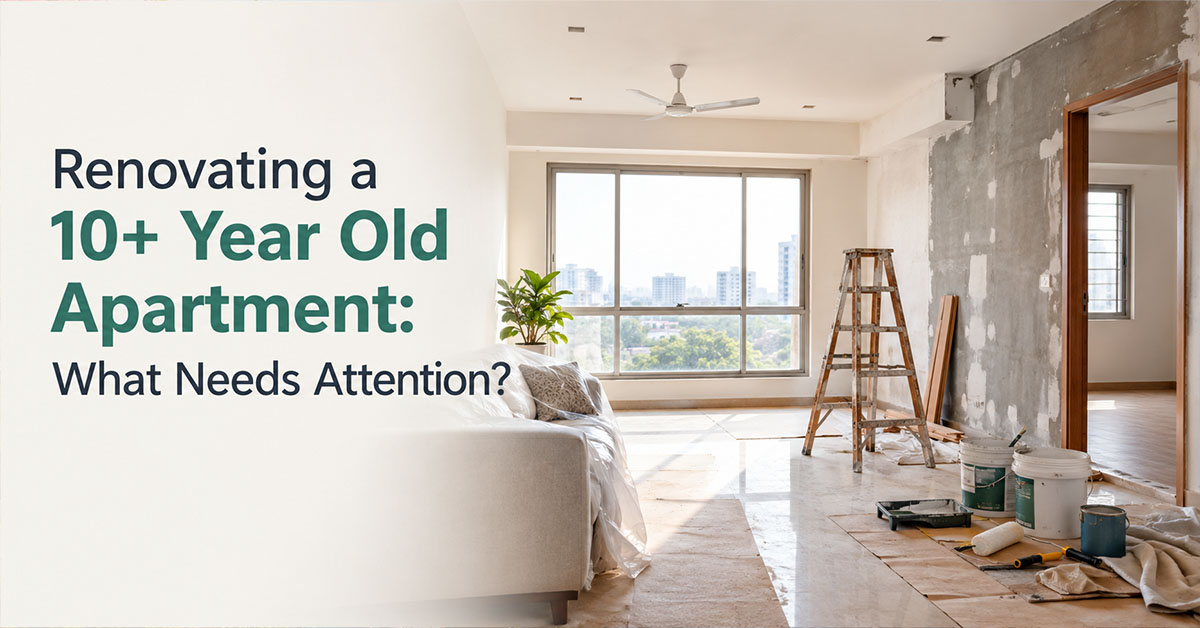
Twelve years is long enough for paint to dull, tiles to chip, and a kitchen layout that felt modern at handover to start feeling dated against anything built today. It’s also long enough for problems nobody can see, wiring insulation breaking down, pipe joints corroding quietly behind tiled walls, to reach a point where they actually need attention rather than just cosmetic patching.
Owners planning a home renovation in Chennai for an apartment past its first decade are dealing with a fundamentally different project than someone freshening up a five-year-old flat, even if both start with the same phrase: “just a renovation.” This piece walks through what actually deserves attention once an apartment crosses that ten-year mark, and why treating it like a cosmetic refresh alone tends to leave the real issues untouched.
Why Ten Years Changes the Renovation Conversation
Most building materials and systems carry a functional lifespan somewhere in the ten-to-fifteen-year range before performance starts degrading in ways that matter. Electrical wiring insulation weakens. Plumbing joints, particularly in older-style piping, become more prone to leaks. Waterproofing membranes on terraces and wet areas lose effectiveness. Not much of this announces itself loudly, it shows up gradually, a slightly discoloured ceiling patch here, a tap that takes longer to reach full pressure there.
A renovation planned around this ten-year mark needs to look past what’s visibly worn and assess what’s structurally and functionally aged, even where it isn’t obvious yet.
Electrical Systems Deserve a Full Review, Not a Patch Job
Apartments built over a decade ago were often wired for a different era of electrical demand, fewer appliances, lower overall load, and wiring standards that have since evolved. Adding modern kitchen appliances, air conditioning units, or additional lighting circuits onto ageing wiring without a proper assessment creates real risk, not just inconvenience.
A few things worth having checked specifically:
- Whether existing wiring gauge can safely handle current appliance loads
- Condition of insulation on wiring behind walls, which degrades with age and heat exposure
- Whether the electrical panel itself needs upgrading to support additional circuits
- Earthing and safety compliance against current standards, which may have changed since original construction
Plumbing Systems Often Need More Than a Fixture Swap
A ten-year-old apartment’s plumbing has typically seen a decade of mineral buildup, gradual pipe wear, and joint stress that isn’t visible from outside the wall. Replacing a tap or showerhead without examining what’s behind it often means solving a symptom while leaving the underlying pipe condition untouched.
Points worth confirming before finalising scope:
- Whether existing pipe material and joints show signs of corrosion or reduced flow
- Whether water pressure issues stem from pipe condition rather than just fixture quality
- Whether concealed leaks have caused any gradual, unnoticed damage to surrounding structure
- Whether older piping materials used at construction time still meet current safety standards
Waterproofing Rarely Holds Up Silently for a Decade
Waterproofing membranes, particularly around terraces, bathrooms, and balcony areas, have a limited effective lifespan, and a decade is often enough for that protection to have quietly failed in places. This becomes especially relevant in a climate with a heavy monsoon season, where compromised waterproofing shows up as seepage, damp patches, or peeling paint long before anyone thinks to investigate the membrane itself.
Renovating an older apartment without re-evaluating waterproofing in these areas tends to mean redoing the same repair again within a few years, once the underlying issue resurfaces through fresh paint and tiling.
Structural Elements Warrant a Closer Look Too
While most residential apartments don’t develop major structural concerns within a decade, minor issues, hairline cracks, slight settling, or plaster deterioration, are worth having assessed rather than simply covered over during cosmetic work. A professional assessment at this stage costs considerably less than discovering a structural issue mid-renovation, once walls are already opened up and contractors are already on-site.
Layout and Functionality Deserve Reconsideration
Beyond the technical systems, a decade is long enough for a household’s needs to shift considerably. A kitchen layout designed for the cooking practices of a decade ago may not suit the current use of the space.Storage that felt adequate at move-in often falls short as belongings accumulate over the years.
This is where a renovation becomes an opportunity rather than just maintenance, reconfiguring layouts, improving storage, and updating finishes to match how the household actually lives now rather than how it lived a decade ago.
Prioritising Where the Budget Actually Goes
With multiple systems potentially needing attention at once, sequencing matters. Structural and safety-related work, electrical, plumbing, waterproofing, generally deserves priority over purely cosmetic upgrades, since these are the elements that become significantly more expensive to fix once finishes are already in place over them.
A practical approach typically works through:
- Structural and safety assessments first, before any finishing decisions are locked in
- Electrical and plumbing upgrades next, since these often require opening walls or floors
- Waterproofing addressed alongside any wet area renovation work
- Cosmetic and layout changes finalised once the underlying systems are confirmed sound
Why This Calls for Experienced Renovation Planning
Renovation Jumbo has built a strong reputation across Chennai for handling full-scope renovation work, structural assessments, electrical and plumbing upgrades, waterproofing, and finishing, all coordinated under one team rather than requiring homeowners to manage multiple contractors separately. That kind of coordinated approach matters particularly for older apartments, where systems interact in ways that are easy to miss when different trades work in isolation.
Approaching an Older Apartment Renovation With the Right Priorities
A renovation on an apartment past its first decade works best when it looks past the visible wear and addresses what’s aged out of sight, wiring, plumbing, and waterproofing chief among them. Getting these fundamentals right first protects whatever finishing work follows. For owners planning to update tired spaces alongside these deeper fixes, pairing structural work with a proper kitchen renovation in Chennai ensures the most-used room in the home gets both a functional and cosmetic refresh at the same time, rather than needing to be revisited again in a few years.